





I recently dropped into Christchurch for the three-day Association of Dispensing Opticians New Zealand (ADONZ) 2025 conference – literally and metaphorically. Before coming in to land, a wild southerly wind took the plane from a smooth glide to a ghastly plunge that turned into a juddering rock ‘n’ roll long enough for my unknown travelling companion to grab my arm and start showing me photos of his grandson! To top it off, I then discovered my suitcase hadn’t left Auckland at the same time I had. So, all in all, it was a somewhat bumpy start to my first dedicated dispensing optician (DO) adventure.
My mood lifted, however, the moment I arrived at the Corneal Lens Corporation (CLC) for a pre-ADONZ laboratory tour and detailed look at the exceptional work CLC does manufacturing bespoke scleral and RGP lenses for Australasia from Aotearoa. Seeing the precision and craftsmanship that go into every lens – hand-polished edges, micro-measurements – was fascinating. It set the tone for the conference that would prove equal parts professional, practical and personal.
From turbulence to take-off
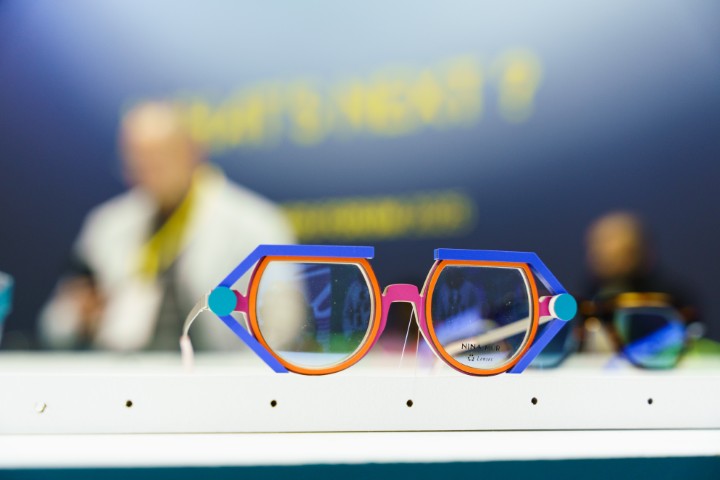
Along with 131 other delegates, I visited sponsors’ stands – spooky in all their Halloween glory – during the morning before the conference-proper began. It was great to see the black-clad booths, brimming with frames, gadgets, giveaways, information and good cheer, humming with activity.
First up, Helen Gleave, Alcon’s senior professional education and development manager, tackled the challenges of how to talk to patients (or should that be customers? This was an ongoing three-day debate) about contact lenses. Gleave’s key point was that around 75% of spectacle wearers have considered contact lenses but never ask about them. Practices that raise the topic early see a far higher uptake than those who don’t. Today’s presbyopes, she said, are largely Gen X and Millennials: image-conscious, health-aware and often dismayed at the first signs of ageing. Offering contact-lens options can restore their confidence and sense of autonomy, she said, outlining three main choices: single-vision distance lenses plus readers; monovision, which becomes limited as adds increase; and multifocal lenses, preferred for maintaining stereopsis and all-day wear. Astigmatism under 0.75D can usually be managed with multifocals; above that, toric or monovision options come into play. Comfort, dryness and realistic adaptation timeframes are crucial. Gleave’s advice was to coach wearers carefully (lighting, mirrors, lid hold, empathy). It’s not just product knowledge but partnership that makes the difference, she said.
How to be a DO all the time
Next up, Chedy Kalach, director and CEO of the Australasian College of Optical Dispensing (ACOD), discussed professionalism – a deceptively simple concept that can make or break patient trust. “We’re all professionals,” he reminded us. “You’re health practitioners. So act like it – not just nine to five.”
Kalach stripped professionalism down to awareness, attitude and consistency. Don’t copy the practice across the road, don’t badmouth colleagues and don’t compare yourself constantly. Focus on your own value: be unique, competent and kind. Keep workspaces tidy, replace faded posters, align your frame displays. Smile, make eye contact, stay approachable – because “resting-bitch-face and crossed arms send the wrong message”. He had the room laughing but his point landed: be friendly, not familiar; chummy, but not too chummy. “The standard you walk past is the standard you accept,” he said. Fingernails and shoes, he added wryly, are what patients notice first.
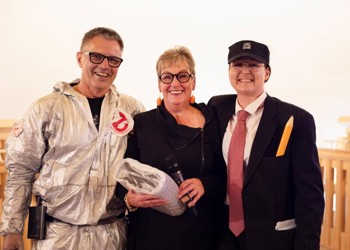
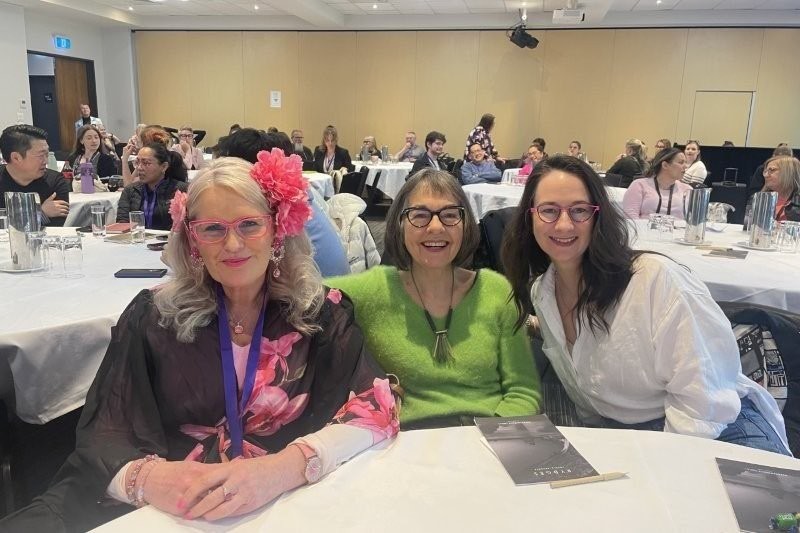
Steve Stenersen, Peggy Savage and Courtney Chellew.
Credit: Heather Joy Photographs
Blue light and bright ideas
Kalach’s colleague, effervescent ACOD director James Gibbins, followed with a clear, evidence-based update on blue light – a topic that continues to divide both public and professionals. Gibbins separated fact from fiction: while UV light is proven harmful, there’s no robust evidence that ordinary blue light from screens causes retinal damage. The key issues are sleep disruption and digital eyestrain, both better addressed through behaviour than filters. Blue-light lenses may provide subjective comfort, but their physiological benefit remains unproven, he said. “Be transparent. Say the evidence is mixed and avoid emotive marketing.” He also reminded us that Boots UK was fined in 2017 for making misleading claims about blue light to sell more blue-light lenses - a lesson in ethics and honesty, he said, adding somewhat sombrely: “Most dispensing opticians sell blue-light filters occasionally, but few wear them themselves.”
Living with vision loss
A highlight was Dan Shepherd, general manager of Community and Inclusion at Blind Low Vision NZ (BLVNZ), accompanied by guide dog Ezra. With understated humour, Shepherd described his lived experience of vision loss and how BLVNZ supports New Zealanders through orientation and mobility training, adaptive daily-living programmes, accessible technology and the country’s elite guide-dog service. BLVNZ currently supports 16,000 people but estimates around 188,000 could benefit from its services. Shepherd’s message was simple: early referral changes lives. “You can refer clients directly via our website – help us reach the people who don’t yet know we’re here.”
Honourable endeavours
ADONZ’s Halloween gala dinner saw a riot of witches, ghouls and unrecognisable colleagues ensconced at the Cardboard Cathedral. Two ADONZ life memberships were awarded this year, one to John Ruby, a specialist eyewear consultant at Black Gates Optometrists in Lower Hutt, and the other to Wellington DO and Royal New Zealand Foundation of the Blind director John Billings. Peggy Savage, former ADONZ president, practice owner and DO with Matthews Eyecare in New Plymouth, was honoured with The Directors Award. Established in 2022, this recognises contributions to the advancement of DOs through service to education, improving awareness of the profession, representation in the optical industry or outstanding service to the Association and its members. President Courtney Chellew said Savage deserved the award for her lasting legacy in education and fighting for the yet-to-be-won DO diploma.
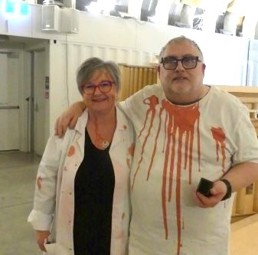
Life member Vanessa Cumming presented
John Billings with his life membership
Insight and innovation
Saturday opened with Samantha Fleming, Northland DO and founder of The Eye Lady, presenting on Irlen syndrome. Fleming explained how neuroimaging shows over-activation in visual-processing regions among people with Irlen syndrome – activity that normalises when wearing individually tinted filters. International studies suggest 12–14% of the population may be affected, rising to one-third among people with ADHD, dyslexia, autism or post-concussion symptoms.
In New Zealand, data are scarce, so Fleming is launching a school-based study screening students from years 3 and 4 for Irlen indicators, vision issues and learning outcomes, comparing intervention and control groups. Her goal: to quantify prevalence and impact and build an evidence base for early recognition, she said. “We need to understand what’s happening in our own backyard.”
Sustainability and the future of frames
Kalach returned to the stage to challenge us on sustainability. “You can have a great business, but if there’s no environment, we don’t exist.” He asked DOs to think beyond recycling slogans: where do frames, lenses and packaging actually end up? Recyclers, can crush materials into pavers or speed humps – better than landfill, but not endlessly recyclable, he said. “If that paver can’t be recycled again, you’ve just delayed waste by six months.” Sustainability, he argued, means examining the full life cycle: source, use, reuse and afterlife. It’s about honesty, not green gloss, he said.

MC Stephen Caunter with group costume award winners,
the Addams family: Lisa Paenga, Sarah Wyllie and Gary Devlin.
Credit: Heather Joy Photographs
AI with empathy
Business mentor and former Glaucoma Australasia CEO and partner of James Gibbins, Annie Gibbins, reframed artificial intelligence (AI) as, “the fifth industrial revolution” - an era where human intuition and machine learning combine to create intelligence with empathy. Rather than fearing AI, she urged us to see it as “a new lens to view the world – and the patterns within it”. Used well, AI can enhance efficiency, personalise care and strengthen patient relationships, she said, adding, AI isn’t replacing people – it’s helping us see more clearly and connect more deeply. “Our future, is the sum of today’s patterns.”

Isobel Black won best-dressed female for her
majestic hand-crafted bird costume
Te Tiriti and cultural safety
The conference took a more reflective turn with Andrew Judd, DO and former mayor of New Plymouth, who delivered a moving plea for genuine engagement with Te Tiriti o Waitangi. He asked bluntly why the conference hadn’t opened with a Māori welcome and how many of us knew our pepeha (personal introduction). Some admitted they didn’t even know the word. His honesty – and humility – resonated. Understanding Te Tiriti, he said, isn’t optional. It’s part of who we are and how we practise.
Angela Mitchell, DO and partner at Orewa Optics, picked up Judd’s thread, outlining exactly how Te Tiriti obligations flow through the HPCA Act and the ODOB’s cultural-safety standards. Cultural safety is a professional and legal requirement for every practising DO, she said. Under Te Tiriti, DOs must deliver equitable, culturally safe care for Māori – acknowledging that health outcomes are shaped by colonisation, access barriers and historic mistrust. Building whanaungatanga – strong, respectful relationships – is key, she said, urging DOs to take time to listen, involve whānau in decisions and recognise patients’ spiritual as well as physical wellbeing. Cultural safety begins with small, daily actions: correct pronunciation, allowing space for karakia (prayers), respecting whakapapa (line of descent) and identity, using plain, inclusive communication. It’s not a checklist but a continuing relationship grounded in respect, reflection and partnership, said Mitchell, who recommended several resources:
The Optometry and Dispensing Opticians Board (ODOB) lists cultural safety and professional conduct standards – required Te Tiriti training for new registrants – and hosts a list of approved Te Tiriti courses:
Other practical tools include pepeha.nz, to create and practice your pepeha, and Te Aka Māori dictionary, for word meanings and pronunciation audio.
Refractive realities and MIGS
After lunch, ophthalmologists Dr Zea Munro, Fendalton Eye Clinic, and Dr Rahul Dwivedi, Southern Eye Specialists, put the focus on all things clinical. Dr Munro’s refractive-surgery update underscored one simple truth: know your patient. “There isn’t one procedure that fits everyone,” she said, matching the right surgery to the right person depends on both ocular anatomy and lifestyle expectations. Photorefractive keratectomy, she explained, remains the safest surface treatment but involves discomfort and slower recovery. LASIK, with its corneal flap, allows for faster healing, while SMILE (small-incision lenticule extraction) preserves more corneal nerves, maintaining tear-film stability. The ideal SMILE candidate is a moderate myope with good corneal thickness, said Dr Munro. “Talk extensively,” she urged, “because patients will compare their recovery to a friend’s LASIK from 20 years ago.”
Dr Dwivedi provided a masterclass on minimally invasive glaucoma surgery (MIGS), which has opened up a new middle ground between medical and traditional surgical management of glaucoma, he explained. The goal remains the same, however: lowering intraocular pressure, but through micro-scale procedures with faster recovery and fewer clinic visits. He outlined three main categories:
Patients need to be counselled realistically, he said, as MIGS isn’t a miracle cure, it’s a way to delay or avoid higher-risk surgery. Device choice depends on anatomy and disease severity, not marketing hype, he added. “It is important to be aware of MIGS because you’ll increasingly encounter patients who’ve had these devices implanted. When they come in for new spectacles or refraction, it’s helpful to note any mention of a stent in the patient history or discharge summary. You don’t need to see it, but it’s good to know that the eye has had surgical modification so that any unusual appearance or symptoms can be handled with care or referred appropriately.”
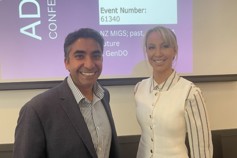
Drs Rahul Dwivedi and Zea Munro
Little eyes, big lessons
Dr Dwivdi’s Southern Eye colleague, Dr Liz Conner, then turned our focus to paediatric ophthalmology and genetics. Her session on PAX6 mutations revealed just how interlinked ocular and neurological development can be. PAX6 is a master gene influencing the formation of the entire eye, she explained. Mutations can lead to small eyes, corneal opacity, foveal hypoplasia and, over time, limbal stem-cell failure and dry eye. Children with aniridia (absence of the iris) often struggle with glare and reduced vision. Surgery offers limited gains and carries risks, making early, coordinated care essential, she said. For DOs, regular review, accurate refraction and well-fitted spectacles are critical during the crucial 0–7-year neuro-developmental window, said Dr Conner, adding that tinted or photochromic lenses can ease glare and scleral lenses may protect the ocular surface.
Parents often worry about how glasses will make their child look, she said. “Our job is to reassure them that early correction isn’t cosmetic – it’s neurological.” Every bit of light and contrast supports motor skills, cognitive development and quality of life. “You’re helping build the bridge between brain and eye.”
Stock sense and business sanity
The afternoon shifted to the practical with Vineet Chauhan, DO, past-ADONZ president and EssilorLuxottica’s New Zealand territory manager, whose talk on stock management turned out to be unexpectedly riveting. His premise was simple: good data beats good guessing. Using 12 months of sales history – a full year to capture all four seasons – practices can track what really sells, what stagnates and how that aligns with local demographics. Chauhan urged DOs to compare their shelves with their sales mix: if 25% of sales are women’s plastic frames but only 8% of the display is, there’s a mismatch. Over-stocking ties up cash; under-stocking sends customers down the road. Smart merchandising, he said, starts with counting pegs, capping brands (no more than 20 with 10–12 units each), limiting price points to two per brand and reviewing fortnightly. Meet reps three to four times a year, not weekly, and set strict back-order limits. “Stock rotation is not a clearance strategy,” he stressed. His mantra stuck a chord: “Data, discipline and display” – when those align, cashflow smooths out and stress levels drop, he said.

New ADONZ president Laura McLaren and
Russel Woodland, best dressed man.
Credit: Heather Joy Photographs
Seeing through MS
By late afternoon, attention spans should have been flagging, but Christchurch Hospital’s neurology registrar Dr Dong Kim kept the room wide awake with a passionate discussion of visual issues in multiple sclerosis (MS). MS is an autoimmune demyelinating disease of the central nervous system – the brain, spinal cord and optic nerve. Astoundingly, it is more prevalent the further you live from the equator, meaning higher rates in Christchurch than in Auckland!
Optic neuritis often heralds the disease, causing unilateral vision loss, pain on movement and changes in contrast and colour vision, said Dr Kim. Though recovery is common, subtle deficits linger. Other ocular signs include internuclear ophthalmoplegia and diplopia. DOs should stay alert to fluctuating vision, visual-field defects and prism needs and note that some MS medications, like fingolimod, can induce macular oedema. Comfort and adaptability should guide frame and lens choices for people with MS, said Dr Kim, highlighting how adaptable both the visual system and clinical care can be to show that MS does not end a person’s independence.
The beauty of the beast
The final session was presented by Gary Devlin from Visual Optics, who turned what could have been a technical slog into a workout in aesthetics and empathy. High-prescription dispensing is both beauty and beast, he said, adding, thick lenses, heavy optics, optical challenges and endless opportunities to make someone feel confident again. Devlin also shared some practical wisdom: choose smaller, rounder lenses to reduce edge or centre thickness; use darker, thicker rims to disguise bulk; and ensure bridges are stable. Rimless styles often emphasise thickness, he said, and base-curve understanding is vital – high-plus lenses need steep curves, high-minus flatter.
Digital aspheric and null-thinning technologies have revolutionised what’s possible, said Devlin, delivering better cosmesis and comfort. His conclusion: when you get a high-prescription dispense right, you don’t just change how a patient sees, you change how they feel about being seen!
ADONZ 2025 echoes that sentiment as a good conference can really enrich how a person feels about the subject matter. Hope to see you all again in Palmerston North for ADONZ 2026!