







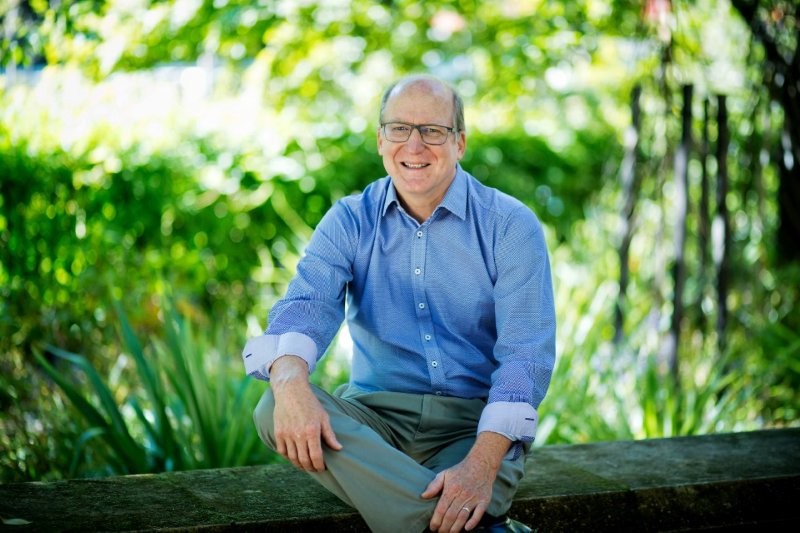
A Dunedin Study team member, The University of Otago’s Distinguished Professor Cliff Abraham, has been awarded New Zealand’s most prestigious scientific award, the Rutherford Medal.
The Royal Society Te Apārangi’s Rutherford Medal recognises Prof Abraham’s “breakthrough advances in the understanding of the neural mechanisms of memory and for providing inspirational leadership for neuroscience in Aotearoa” and is accompanied by prize money of NZ$100,000. His research focus is understanding how the plasticity of the brain’s neuronal cells underpins humans’ ability to learn and form long-term memories.
As part of his work on the Dunedin Study, Prof Abraham helped develop eye-based diagnostic tools for Alzheimer's disease. “While my work has largely avoided the visual system in our animal studies, we have done one study in rats that showed it is possible to use particular visual stimulation patterns to generate plasticity at synapses in the visual cortex.” This methodology has been shown to work in humans as well by groups at the University of Auckland and is being trialled as another diagnostic for memory-impairing disorders such as Alzheimer’s, he said.
Dunedin Study data published from the age-45 cohort indicates the thickness of retinal layers correlate with measures of brain ageing and risk factors for development of Alzheimer’s, said Prof Abraham. “We hope to find out from the age-52 assessments how consistently these measures track across time. It’s too early to tell though whether [they] are more about brain ageing generally, or specific disease processes like Alzheimer’s.” He also has an ongoing collaboration with an Auckland group looking at mouse retinas from his colony that models Alzheimer’s disease. “It will be interesting to see how these findings compare with those in the human studies,” he said.
The Rutherford Medal is awarded yearly for pre-eminent research, scholarship or innovation in any field, or fields, of engineering, humanities, mathematics, sciences, social sciences or technology. It was awarded in 2022 to the Dunedin Study, a long-running, multidisciplinary study of human health, development and behaviour that has followed 1,037 babies born in Dunedin between 1972 and 1973. Prof Abraham described the award as a massive honour and the most significant of his career. “It recognises not just my own research, which is very much a team effort, but also my contributions to promoting and leading a nationally collaborative research effort and ethos across Aotearoa. It’s also very humbling to be counted among those amazing scientists who have received it before me.”
Although he said he doesn’t yet have any specific plans for how to use the prize money, which is a personal award, “there will be discussions with my family about this, no doubt!”