





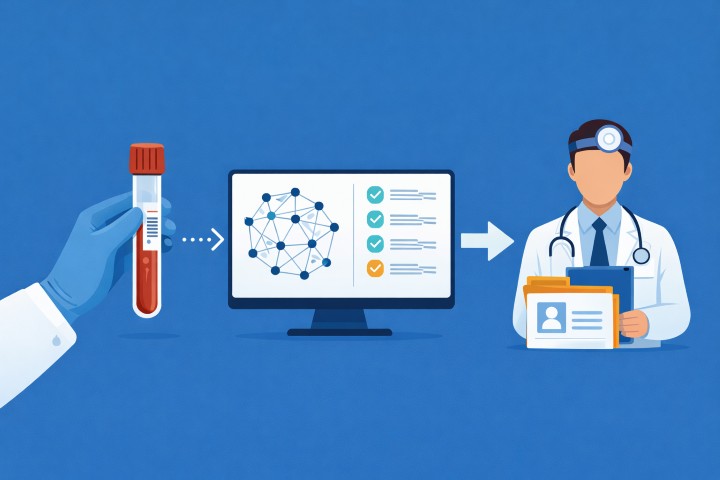
Researchers in China found large-scale AI analysis of routine blood tests could help identify patients at higher risk of seven blinding eye diseases and prioritise them for confirmatory ophthalmic assessment.
Writing in Nature Health, the Eye & ENT Hospital of Fudan University-led team described a machine learning-based multi-disease eye screening (MES) framework designed as a scalable, non-invasive triage aid. The system identified age-related macular degeneration, age-related cataract, diabetic retinopathy, glaucoma, retinal detachment, retinitis pigmentosa and retinal vein occlusion. In real-world clinical and community settings, the MES test showed strong predictive performance, with positive predictive values of 95.9% and 93.1%, and negative predictive values of 96.0% and 99.1%, respectively.
The model was developed using data from 93,839 participants and validated in 33,622 individuals. Evaluation was carried out in three external cohorts totalling 34,087 people, a prospective hospital-based cohort of 43,556 and a population-based cohort of 498,095.
The authors said the MES framework’s performance remained robust across age and comorbidity subgroups, supporting its potential as a large-scale referral tool.