




OphthalmoPro has outlined several developments in its New Zealand dry eye portfolio, including the installation of an Eye-light device at Auckland University’s School of Optometry and Vision Science (SOVS) and the launch of two new topical products.
SOVS purchased the Eye-light device, distributed by OphthalmoPro, to deliver low level light therapy (LLLT) treatments with both the red mask and blue mask, company territory manager David Harris said.
During a recent demonstration, LLLT provided immediate symptomatic benefit for some patients, he said, in contrast to intense pulsed light (IPL) treatments that may require multiple sessions. The device can also be used to treat Sjogrens syndrome and stubborn chalazia. “With LLLT safe for children as young as seven years old this offers a lot of clinical potential when compared to IPL alone,” Harris said.
“A patient who received treatment reported that her eyes felt ‘softer’ and that it was ‘easier for expression’ after the low-level light therapy. The patient, who’d had previous dry eye treatments, noted how much better the treatment felt compared with IPL alone, particularly commenting on the improved sensation during the post-treatment eye squeeze. This was her first experience with combined IPL and low-level light therapy,” said Harris.
The Eye-light device with red mask and IPL cartridge is used for the management of meibomian gland dysfunction and evaporative dry eye, as well as management of chalazia and styes. Its placement within the university clinic means optometry undergraduates will be exposed to the technology during their training, said Harris. He added that 19 Specsavers locations in New Zealand are currently using the device, along with several independent optometry and ophthalmology practices.
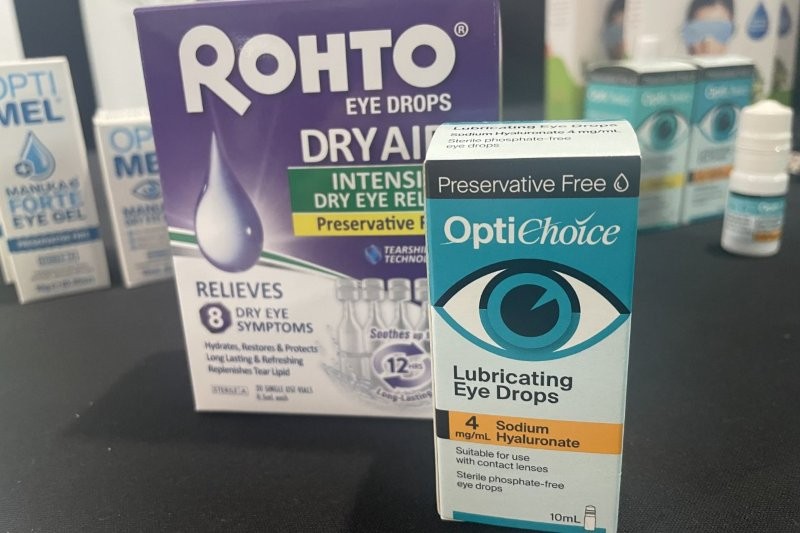
Meanwhile, the company has launched Rohto Dry Aid in a preservative-free formulation in New Zealand. These drops have a formulation that addresses both the lipid and aqueous layers of tears and are effective for mild to severe dry eye. “Key ingredients of castor oil and sesame oil work together to deliver a highly effective treatment for dry eye, while menthol addresses the discomfort and grittiness with a cooling, soothing sensation,” Harris said.
He said the new drops are particularly beneficial for people spending long days in air-conditioned spaces, or those who have been outside a lot. “The menthol sensation is more noticeable for people with drier eyes.”
The third development is the introduction of a preservative-free 0.2% and 0.4% hyaluronic acid eye drop, the latter being the first formulation of that concentration available in Australia and New Zealand, said Harris.
“Hyaluronic acid occurs naturally in the eyes and most existing products in the market contain 0.1% or 0.2% concentrations, with some 0.3% options available, making this 0.4% concentration the highest available.”
He said the higher concentration product is targeted at more moderate to severe dry eye cases for longer-lasting relief, particularly helping to repair pitted eye surfaces that can be seen on tear-film analysers.