







People with deteriorating vision could see better and retain useful vision longer if new therapies developed at UC Berkeley work as well in humans as they do in mice, say researchers.
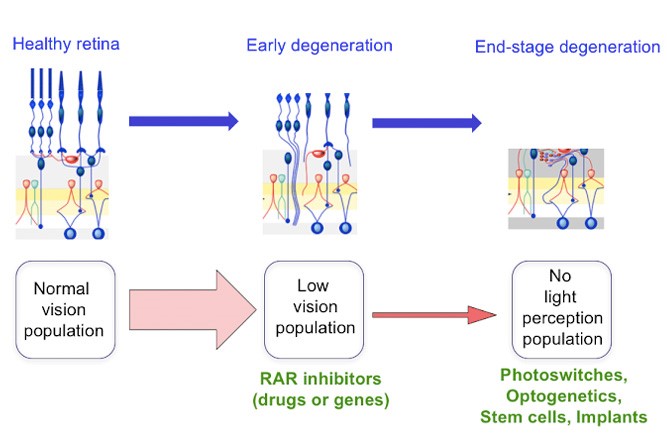
The treatments, involving either drug or gene therapy, work by reducing the noise generated by nerve cells in the eye, which can interfere with vision much the same way tinnitus interferes with hearing. UC Berkeley neurobiologists have shown this approach improves vision in mice with retinitis pigmentosa and are hopeful it will also bring images more sharply into view for people with retinitis pigmentosa and other types of retinal degeneration, including age-related macular degeneration (AMD).
“This isn’t a cure for these diseases, but a treatment that may help people see better,” said neuroscientist Richard Kramer, a professor of molecular and cell biology at UC Berkeley. “It won’t put back the photoreceptors that have died but may give people an extra few years of useful vision with the ones that are left.”
Kramer’s lab is testing drug candidates that already exist. He anticipates the new discovery will send drug developers back to the shelf to retest other drugs which work in a similar manner by interfering with cell receptors for retinoic acid.
Kramer and his UC Berkeley colleagues reported the results of their mice studies in the journal Neuron in March.